The leave and absence sessions at the IBI Forum point to a common challenge: an employer may offer strong programs, yet the employee experiences them through separate systems and organizations. The HCM holds employment and payroll information. A leave administrator tracks the absence. A carrier manages a disability or paid leave claim. Benefits, pay, accommodations, and return to work may each have another owner. Coordination across those sources is what turns a collection of programs into support an employee can use.
The session on integrated workforce data approached coordination from the employer’s perspective: bringing information together makes it possible to evaluate results across disability, health, and time away from work. The Honeywell and Truven session similarly emphasized a more complete view for benefits decisions. For leave, that means seeing the whole journey rather than a claim, payroll record, or vendor report in isolation. Employers need to know whether an absence was recorded correctly, a benefit was approved, pay continued as expected, and the employee returned with the right support.
The GEICO session on redesigning absence and leave, along with the discussion of insourcing, outsourcing, and co-sourcing, raised an operating question: who is responsible for making those pieces work together? An employer can choose any of those service models. The employee still needs a coherent experience across the handoffs. Changing vendors or assigning responsibilities will accomplish little if information is delayed, inconsistent, or invisible to the people trying to help.
The second theme is trust. The session on leave as a driver of retention described leave as a defining moment in an employee’s relationship with an employer. When someone is ill, caring for family, or preparing to return to work, they should not have to reconstruct their own case across HR, payroll, an administrator, and a carrier. They need confidence that the employer knows what has happened, what comes next, and who will resolve a problem.
That trust depends on practical details: clear expectations before leave, accurate pay and benefits during it, timely updates when something changes, and a supported return. Fragmented data can produce conflicting answers precisely when the employee has the least capacity to chase them down. Connected data matters because it gives the employer and its partners a shared basis for action, communication, and follow through.
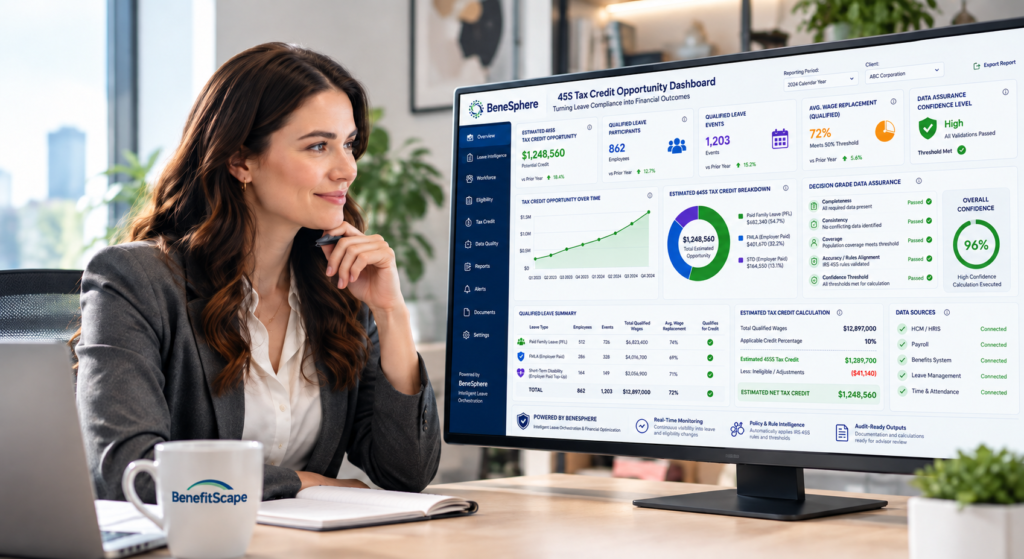
This is the BeneSphere opportunity. BenefitScape can connect and reconcile information from HCM platforms, leave administrators, payroll, and carriers, then make the status and exceptions visible to the people responsible for resolving them. The aim is broader than moving data between systems. It is to help the employer keep its promise to the employee: we will pull this together for you.
The forum’s strongest lesson, viewed through that lens, is that employee trust is an outcome of coordination. Employers earn it when their many systems and partners act like one support system at the moment an employee needs them most.
What the IBI sessions brought forward
The IBI Forum’s leave and absence sessions pointed to a common challenge: an employer may offer strong programs, yet employees experience them through separate systems and organizations. The HCM holds employment and payroll information. A leave administrator tracks the absence. A carrier manages a disability or paid leave claim. Benefits, accommodations, and return to work may each have another owner. Coordination across those sources is what turns a collection of programs into support an employee can use.
The session on making effective workforce decisions with integrated data Lori Skewes, Director of Benefits, Schwan’s Shared Services, LLC and Jennie Wheeler, AVP of Integrated Analytics, WorkPartners added an important dimension. Employers face many point solutions promising measurable returns, but often lack a way to test those claims independently. The case study used an integrated data warehouse, matched comparisons, and before-and-after analysis to examine outcomes across health care use, disability, and total time lost. Its lesson extends to leave: a vendor’s report can describe its own activity, but employers need a view across systems to understand whether the program improved the workforce outcome.
The concept of deploying a fully integrated, holistic KPI dashboard to drive decision-making was presented by Honeywell and Truven, Jenna Andras, Director of Benefits, Honeywell International Inc. and Christine Turner, Truven by Merative emphasized bringing data together to guide benefits decisions. For leave, that means seeing the whole journey rather than a claim, payroll record, or vendor report in isolation. Was the absence recorded correctly? Did the benefit begin on time? Did pay continue as expected? Did the employee return with the right support? These questions require information from several sources and a shared way to interpret it.
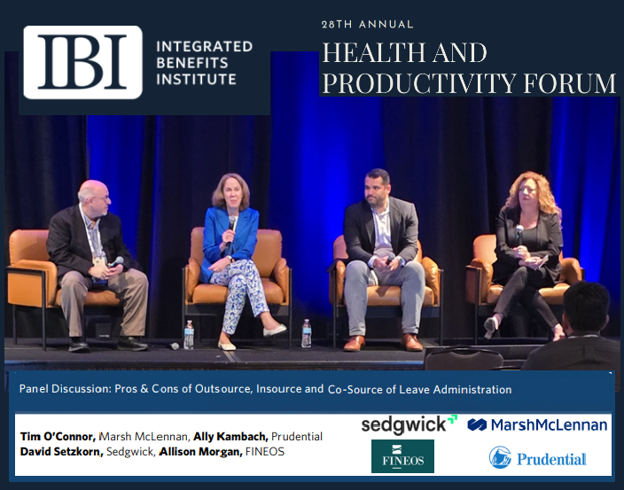
Several sessions on redesigning absence and leave, alongside the discussion of insourcing, outsourcing, and co-sourcing, raised the operating question: who makes all those pieces work together? An employer can choose any service model. The employee still needs a coherent experience across its handoffs. Clear ownership matters when information is delayed, inconsistent, or missing. Ally Kambach, Prudential responded to question on ‘lead time’ to change to a new model at 15 to 18 months, a timeframe agreed to by all the panel participants, Tim O’Connor, Marsh McLennan, David Setzkorn, Sedgwick Allison Morgan, FINEOS
The second theme is trust. The session on leave as a driver of retention described leave as a defining moment in an employee’s relationship with an employer. Someone who is ill, caring for family, or preparing to return to work should not have to reconstruct their own case across HR, payroll, an administrator, and a carrier. They need confidence that their employer knows what has happened, what comes next, and who will resolve a problem.
That confidence is built through accurate pay and benefits, timely communication, and visible follow through. It also depends on the employer knowing whether its programs actually work, based on evidence that reaches beyond any single vendor’s measures.
This is the BeneSphere mission. BenefitScape can connect and reconcile information from HCM platforms, payroll, leave administrators, and carriers, making outcomes and exceptions visible to the people responsible for them. That connected view can support both independent evaluation for the employer and coordinated action for the employee.
The aspiration is straightforward: when an employee needs leave, the employer can credibly say, “We will pull this together for you.”