This three-part series on AI & REGTECH has been created by BENEFITSCAPE to provide a framework for how AI can support benefits administration and compliance — and where its role should be limited.
The series concludes with 7 takeaways, built around two core principles:
1. Use clearly defined rules to make reproducible compliance decisions. In other words, don’t put AI inside your regulatory rulebook.
2. And when AI is used to support diagnostics, workflows, or content creation, depply it around a well-defined, deterministic decision architecture. In other words AI must only have governed access to context, recorded outcomes, supporting evidence, and simulation tools.
Putting these principles into practice requires clear boundaries:
Which tasks should AI assist? Which decisions should follow defined rules? Where is human judgment essential?
1. AI needs its own governance.
AI comes with its own compliance risks, from data security and privacy regulations to intellectual property issues. Make sure your company and service providers understand and use the NIST AI Risk Management Framework [AI RMF], including its the Generative AI Profile to guide their use of AI.
Define what AI can access, how its outputs are checked, and when human review is required. If in any doubt, ask BENEFITSCAPE to audit your use of AI.
2. Match the technology to the task.
AI is a broad category of technologies — one size does not fit all tasks. Make sure you and your service providers understand both AI and benefits in order to select, configure, and validate the right tools for different ben admin and compliance tasks.
Two supporting roles are particularly useful:
Generative AI can help extract and summarise information, answer questions using approved sources, and explain recorded outcomes.
Discriminative AI can support diagnostics by identifying patterns, classifying records, and flagging potential errors or anomalies for review.
Both roles need clear boundaries.
Where a regulatory obligation depends on defined eligibility criteria, thresholds, or calculations, use explicit rules and conventional software to produce a reproducible result. AI can help prepare information, identify issues, and explain the outcome, with human expertise available to resolve questions and exceptions.
3. For compliance, ‘weak’ AI can be a strength.
‘Weak’ may sound like the wrong quality for compliance.
In AI, it describes a system focused on specific tasks. ‘Strong’ AI refers to the ambition of broader, human-like general intelligence.
A defined task gives you something concrete to check. Did the AI extract information correctly, explain a decision accurately, or flag a potential error?
That focus makes performance easier to assess. It does not guarantee reliability. AI still needs testing against relevant data and monitoring in use.
4. Ground generative AI in a defined, approved data set.
Generative AI should clarify, not determine, compliance.
It can explain requirements and outcomes; clearly defined rules and qualified specialists determine those outcomes.
Everyday tools that answer questions and generate text, images, video, and audio have been rapidly adopted. In ben admin, applications include employee support chatbots, information extraction, summaries, and draft explanations.
Although models may be trained on vast quantities of data, these applications should draw on a defined, approved data set of benefits documents, regulatory guidance, and recorded decisions. Keep it current, control access, and make answers traceable to supporting sources. Refer questions to a specialist when the evidence is insufficient.
A fluent answer is not proof of accuracy. Check extracted information against its source and explanations against the recorded decision.
5. Use discriminative AI to support diagnostics.
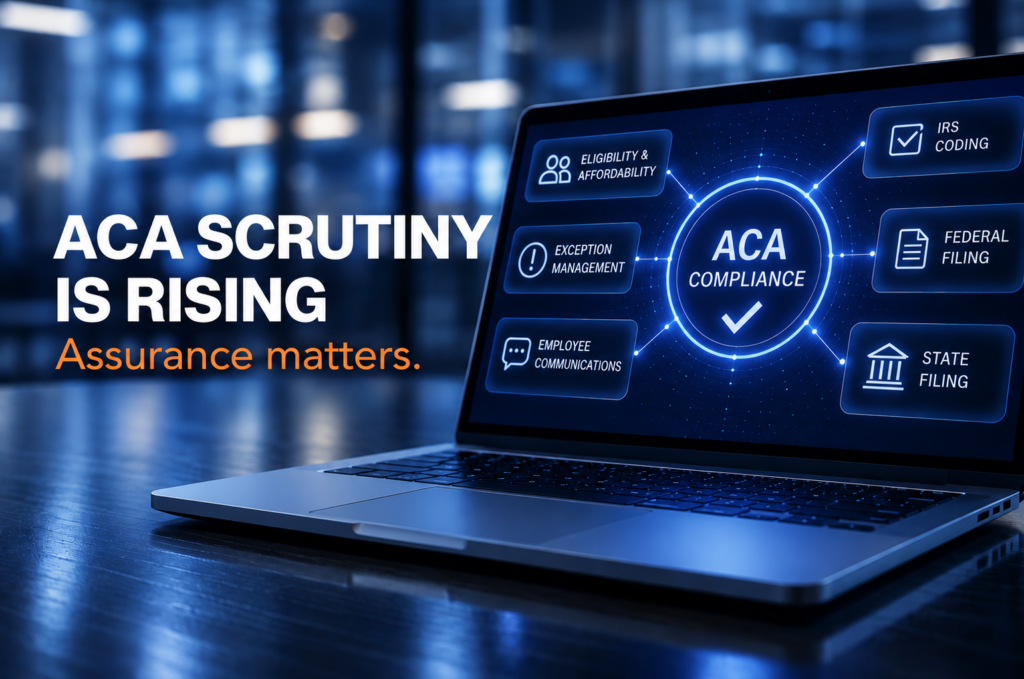
Discriminative AI can help classify records and flag inconsistent data, suspicious patterns, and potential errors in complex compliance datasets. BENEFITSCAPE ACA_REGTECH, for example, uses intelligent Flag & Fix diagnostics on ACA reporting and compliance data.
A flag is a reason to investigate. It does not establish a violation, and the absence of a flag does not establish compliance. Diagnostic findings should feed into a defined review and correction process. Any resulting compliance decision should follow the applicable rules and be supported by evidence.
6. Sometimes rules are just rules. AI is simply not needed.
As outlined in takeaway 2 above, where compliance depends on defined eligibility criteria, thresholds, or calculations, use explicit rules and conventional software to produce a reproducible result.
AI is a tool, not a universal, plug-and-play autonomous solution. Build a Human-in-the-Loop architecture, with qualified benefits specialists reviewing findings, resolving exceptions, and approving consequential actions. AI supports the process; human benefits expertise remains the ultimate risk and compliance safeguard.
The same applies to simulation.
Use the governed rules to calculate hypothetical outcomes, and clearly distinguish those scenarios from approved compliance decisions.
7. Remember, the IRS uses AI too.
The IRS uses AI and advanced analytics to identify potential non-compliance and help target enforcement activity. See ‘AI & Regtech Transforming IRS Powers,’ ACA-To-Z Blog [29 April, 2024].
For employers and their providers, the takeaway is practical: identify inconsistencies before filing, investigate diagnostic flags, and retain evidence supporting your compliance decisions. Be ready to explain how an outcome was reached, which rules were applied, and who reviewed it.
BENEFITSCAPE was founded in 2014 to bring together leading expertise in both ben admin and new technologies, including the pioneering use of intelligent new regtech. Today the company has a proven track record in delivering best-in-class ben admin and compliance services for 1000s of employers on all HCMs.
To discuss how this approach can support your benefits administration and compliance, email BENEFITSCAPE at info@benefitscape.com or call +1-508-655-3307.